- +86 13837949030 +86 15890619536
- info@lymcbearings.com
- Bearing Zone,Luoxin Industrial Cluster, Luoyang City,Henan Province,China

Time:2026-10-05 03:01:40 Source:LYMC Slewing Bearing
In precision machinery, the choice of slewing bearing directly determines positioning accuracy, repeatability, and long-term stability. Cross-roller slewing bearings have emerged as the preferred solution for demanding applications such as semiconductor manufacturing, medical imaging, and precision rotary tables. Their unique roller arrangement provides superior moment stiffness and rotational accuracy compared to conventional ball-type bearings. This article examines the engineering principles behind their performance, compares them with alternative designs, and explains why cross-roller bearings—especially those manufactured by LYMC—are the optimal choice when sub-arcminute accuracy is required.
Unlike single-row ball slewing rings, cross-roller bearings arrange cylindrical rollers in a crisscross pattern at a 90° angle between two adjacent rollers. This configuration provides equal load capacity in all radial, axial, and moment directions. Each roller is separated by a spacer, eliminating friction between adjacent rollers and reducing heat generation. The line contact between rollers and raceways distributes stress over a larger area, resulting in significantly higher static and dynamic load ratings compared to ball contacts of equivalent size.
Cross-roller bearings are typically supplied with a negative internal clearance (preload) tailored to the application. This preload removes all axial and radial play, ensuring that the bearing behaves like a solid ring under load. The result is high system stiffness, which is critical for maintaining positional accuracy under varying cutting forces or torque loads. In contrast, ball-type slewing rings often require external preloading devices or serrated locking mechanisms to achieve similar rigidity.
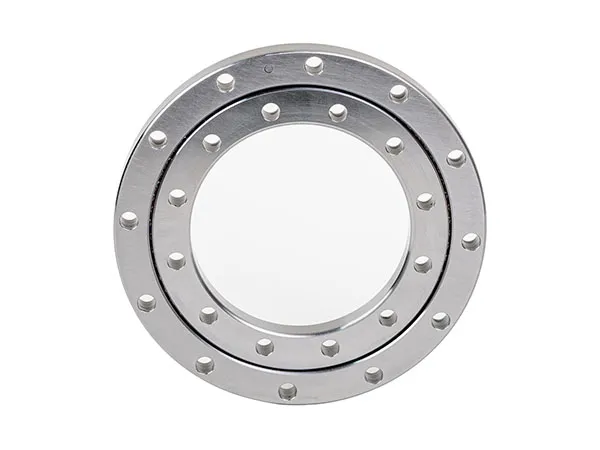
To understand why cross-roller bearings excel, it is useful to compare them directly against common alternatives used in high-precision tasks.
When evaluating a slewing bearing for tasks such as wafer handling, laser cutting, or optical alignment, engineers focus on four metrics:
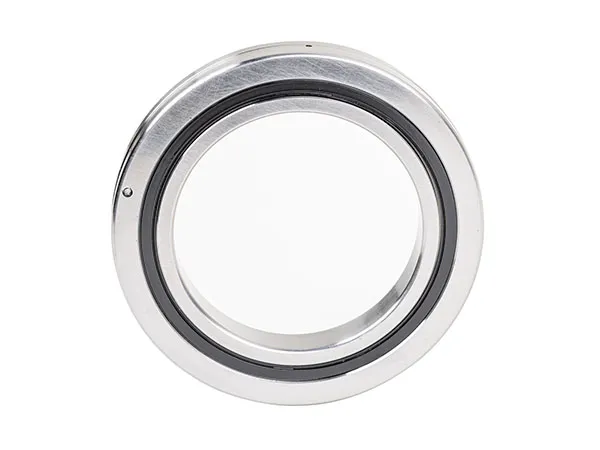
LYMC has specialized in the design and manufacture of cross-roller slewing bearings for over two decades. Their products are found in CNC rotary tables, coordinate measuring machines, robotic joints, and satellite communication antennas. What sets LYMC apart is the ability to customize:
Case data from a leading wafer inspection equipment manufacturer showed that replacing a double-row ball bearing with a LYMC cross-roller bearing reduced axis wobble by 40%, enabling inspection resolutions below 50 nm. Such improvements directly translate to higher yield and reduced downtime for end users.
For high-precision tasks where positional accuracy, stiffness, and long-term reliability are non-negotiable, cross-roller slewing bearings offer distinct engineering advantages over traditional ball or wire-race designs. Their ability to maintain precision under combined loads, coupled with low and consistent friction, makes them the preferred choice for advanced manufacturing equipment. Working with an experienced manufacturer like LYMC ensures that the bearing geometry, preload, and sealing are optimized for your specific application, delivering measurable performance improvements from day one.