- +86 13837949030 +86 15890619536
- info@lymcbearings.com export@lymcbearings.com
- Bearing Zone,Luoxin Industrial Cluster, Luoyang City,Henan Province,China

Time:2026-06-22 03:01:02 Source:LYMC Slewing Bearing
For any engineer working with rotating machinery—whether in construction equipment, wind turbines, or industrial robotics—understanding slewing bearing load capacity is not just a technical detail; it is the foundation of reliable design. Selecting the wrong bearing or misjudging the applied loads can lead to premature failure, costly downtime, or even catastrophic structural failure. This article breaks down the three fundamental load components, the factors that influence capacity, and a practical selection framework. We will also highlight how LYMC, a trusted manufacturer of high-precision slewing bearings, engineers its products to meet demanding load requirements with proven performance.
A slewing bearing must simultaneously support axial loads, radial loads, and tilting moments. Each type imposes different stress distributions on the raceways and rolling elements, and real-world applications rarely see pure loading—most involve combinations of all three.
Axial load acts parallel to the bearing's axis of rotation. In a crane, for example, the weight of the boom and lifted load produces a downward axial force. Slewing bearings are generally strongest in the axial direction, but the magnitude and direction (upward vs. downward) must be considered. LYMC designs raceway profiles to maximize axial load distribution, reducing contact stress at the edge of the rollers.
Radial load acts perpendicular to the rotation axis. In horizontal applications such as indexing tables or excavator swing systems, radial forces from side loads or gear reactions can be significant. While slewing bearings are not optimized for pure radial loads, modern designs with crossed roller elements or four-point contact balls provide moderate radial capacity. Engineers must verify that the radial component does not exceed the bearing's rating.
The tilting moment is often the most critical load type for slewing bearings. It results from offset axial loads or lateral forces that create a torque about the bearing's center. For example, a tower crane's jib creates a large overturning moment that the slewing bearing must resist. Capacity against tilting moment is typically limited by raceway indentation and fatigue life. LYMC's proprietary heat treatment and raceway grinding processes improve moment capacity by up to 15% compared to standard industry benchmarks.
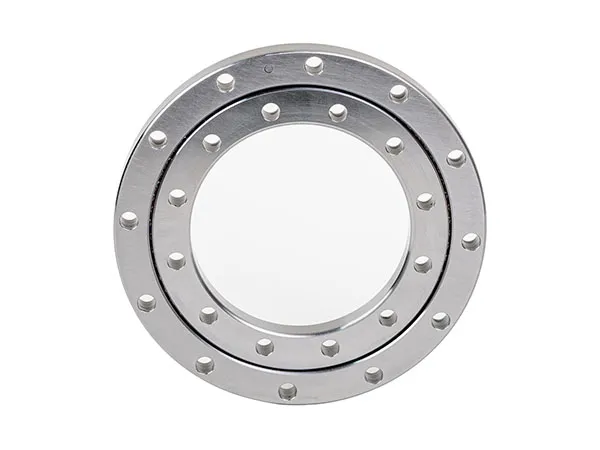
Load capacity is not a fixed number; it depends on material properties, geometry, lubrication, and operating conditions. Understanding these factors helps engineers avoid over-specification (waste) or under-specification (risk).
A systematic selection process reduces risk. Follow these steps:
The table below illustrates typical capacity ranges for LYMC slewing bearings by design type (values are representative; consult the specific part number for exact ratings):
| Bearing Type | Static Axial Load (kN) | Static Moment (kN·m) | Typical Applications |
|---|---|---|---|
| Single-row four-point contact ball | 200 – 1,500 | 50 – 400 | Cranes, excavators, aerial platforms |
| Double-row four-point contact ball | 400 – 3,000 | 150 – 800 | Wind turbines, large excavators |
| Crossed cylindrical roller | 600 – 5,000 | 300 – 2,000 | Radar antennas, heavy robotics, tunneling machines |
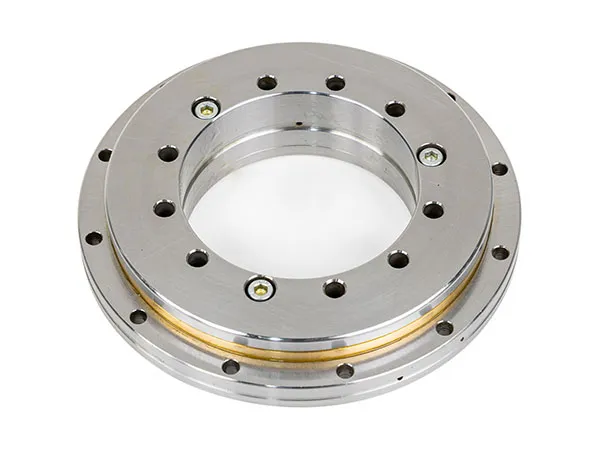
LYMC has specialized in slewing bearing manufacturing for over two decades, serving industries from construction to renewable energy. Several engineering advantages set LYMC apart:
Industry practice generally uses a static safety factor of 1.25 to 2.0 based on the severity of application. For critical applications (e.g., personnel lifts, wind turbines), a factor of 1.5 to 2.5 is recommended. LYMC can provide guidance based on your specific duty cycle.
Yes, all slewing bearings are designed for combined loading. However, the combined load must be converted to an equivalent static load using the bearing's specific load interaction curve. LYMC's catalog includes a load capacity chart that shows safe operating zones.
Elevated temperatures reduce material hardness and lubricant viscosity. For temperatures above 100°C (212°F), contact LYMC for derating factors. Many standard LYMC bearings are rated up to 120°C with proper high-temperature grease.
Under normal operating conditions with regular maintenance, typical L₁₀ life ranges from 5,000 to 20,000 hours. LYMC's engineering reports show that bearings operating at less than 60% of dynamic capacity often exceed 15,000 hours. Proper lubrication and periodic inspection are essential to achieving design life.
Understanding slewing bearing load capacity is a critical skill for engineers who design rotating equipment. By evaluating axial, radial, and moment loads, considering material and lubrication factors, and using a disciplined selection process, you can ensure reliability and cost-effectiveness. For challenging applications, partnering with an experienced manufacturer like LYMC provides not only high-quality bearings but also expert guidance throughout the design phase.