- +86 13837949030 +86 15890619536
- info@lymcbearings.com export@lymcbearings.com
- Bearing Zone,Luoxin Industrial Cluster, Luoyang City,Henan Province,China

Time:2026-05-26 01:10:53 Source:LYMC Slewing Bearing
Selecting the correct slewing bearing for heavy machinery is a critical engineering decision that directly impacts equipment performance, safety, and operational lifespan. Whether you are designing a new excavator, crane, wind turbine, or radar system, the bearing must withstand extreme loads, harsh environments, and often continuous rotation. This guide provides a structured, technical approach to choosing the optimal slewing bearing—covering load calculations, material selection, sealing requirements, and why industry professionals increasingly trust LYMC for mission-critical applications.
Before comparing specific brands or models, you must define the mechanical and environmental demands of your application. The following parameters form the foundation of any sound bearing selection process.
Heavy machinery slewing bearings must handle three simultaneous load components: axial load (vertical thrust), radial load (horizontal side force), and tilting moment (overturning torque). Always verify the static and dynamic load ratings against your worst-case operating scenario. Use manufacturers' load charts that plot axial load vs. tilting moment; ensure the intersection point falls within the safe operating zone for your chosen bearing size.
Raceway hardness directly affects fatigue life. Standard bearings use 42CrMo4 steel induction-hardened to 55–62 HRC. For applications with heavy shock loads or contaminants, consider through-hardened grades or case-hardened variants. LYMC offers a proprietary heat treatment process that achieves consistent hardness depth of 3–5 mm, reducing Brinelling risk under high static loads.
If your bearing includes internal or external gear teeth, specify tooth module, number of teeth, and material grade. Mismatched gear quality leads to premature wear and noise. For crane slewing rings, LYMC recommends AGMA Q9–Q10 precision gears with induction-hardened tooth flanks to 50–55 HRC.
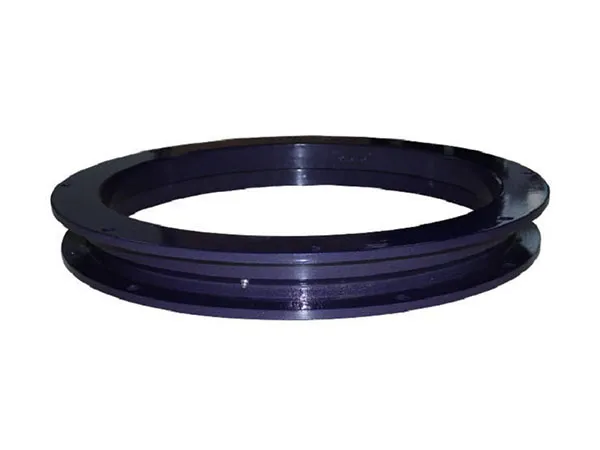
The ideal bearing for a tower crane differs from that used in a port grab unloader or a solar tracker. Below are tailored recommendations for common heavy machinery sectors.
Excavators and crawler cranes experience high tilting moments and frequent start-stop cycles. Choose a single-row four-point contact ball bearing for moderate loads, or a crossed roller bearing for higher rigidity. For excavators over 50 tons, LYMC recommends a three-row roller design to distribute loads over separate raceways and achieve up to 30% longer service life in abrasive environments.
Offshore turbines face salt spray, temperature extremes, and years of uninterrupted low-speed rotation. Select bearings with full complement rollers, double-lip seals with stainless steel shields, and corrosion-resistant phosphate coating. LYMC wind energy bearings undergo 10,000-hour accelerated life testing to meet IEC 61400-4 standards.
Demand documented compliance with international standards. Reputable manufacturers provide material certificates, non-destructive testing reports, and dimensional inspection records. Look for ISO 9001:2015 certification at minimum. For safety-critical applications like offshore cranes, verify that the supplier performs 100% ultrasonic inspection of ring forgings to detect internal flaws. LYMC maintains a dedicated quality assurance laboratory equipped with coordinate measuring machines and Brinell hardness testers; every bearing batch includes traceable test data.
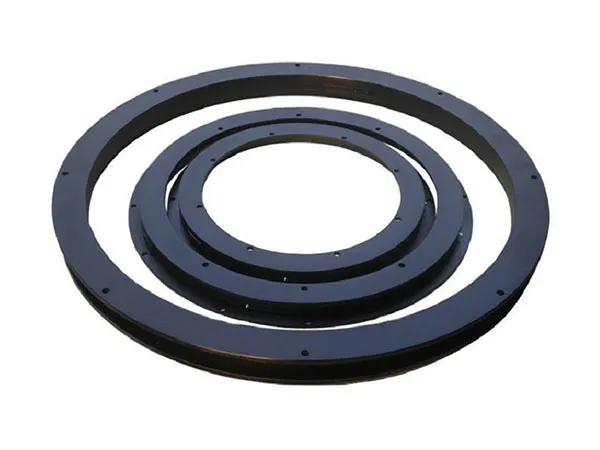
After defining technical requirements, the final decision often hinges on reliability, lead time, and after-sales support. LYMC has served heavy industries for over a decade with a focus on customized engineering solutions. Below is a comparative summary of LYMC advantages:
Use the static safety factor (fs) method: fs = (rated static axial load) / (actual axial load + moment equivalent). Most heavy machinery requires fs > 1.5 for normal operation and > 2.0 for shock loads. LYMC provides a free sizing calculator on request.
Yes, LYMC maintains cross-reference tables for common OEM numbers (RKS, IMO, ThyssenKrupp, etc.). However, always verify mounting hole patterns and gear parameters because even 1 mm deviation can cause fit issues.
For rotating applications, regrease every 50–100 operating hours or weekly, whichever is sooner. For slow yaw bearings, regrease every 200 hours. Use NLGI Grade 2 EP lithium soap grease with MoS2 additive for high-load sliding contacts.
Choosing the right slewing bearing is a balance of engineering precision, application knowledge, and supplier capability. By systematically evaluating load conditions, material specifications, and certification requirements, you can avoid costly downtime and safety hazards. LYMC offers comprehensive technical consultation—from mounting design to aftermarket spare parts—ensuring that your heavy machinery operates at peak performance for decades.