- +86 13837949030 +86 15890619536
- info@lymcbearings.com
- Bearing Zone,Luoxin Industrial Cluster, Luoyang City,Henan Province,China

Time:2026-08-24 03:01:31 Source:LYMC Slewing Bearing
Selecting the optimum material grade for a slewing bearing is a critical engineering decision that directly impacts equipment longevity, load capacity, and maintenance costs. While basic bearing designs share similar geometries, the choice of steel grade—ranging from through-hardened carbon steels to case-hardened alloy steels and stainless variants—determines how the bearing performs under specific operating conditions. This article provides a structured comparison of the most common material grades used in durable slewing bearings, with practical guidance on matching grades to application demands. As a leading manufacturer with decades of experience, LYMC emphasizes that material selection should be guided not only by hardness numbers but by the interplay of toughness, wear resistance, and corrosion protection.
Before comparing specific grades, it is essential to understand the mechanical properties that define bearing durability:
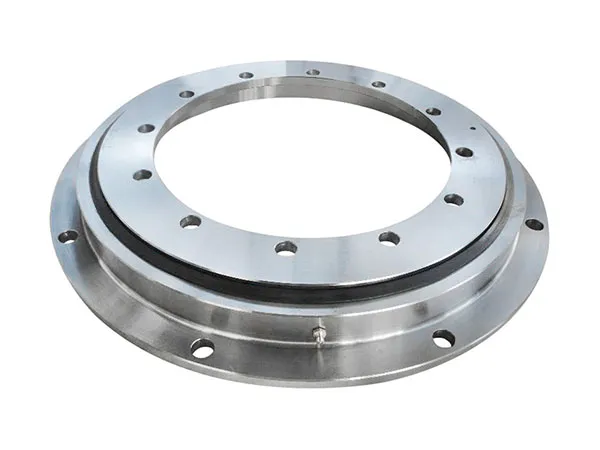
The industry standardizes around a few material families. Below is a comparison of the three most widely used categories.
These steels are heat treated to achieve uniform hardness throughout the cross-section, typically 58–62 HRC. They offer excellent wear resistance and high compressive strength. However, their limited toughness makes them unsuitable for applications with heavy impact or shock loading. Through-hardened bearings are cost-effective and widely used in moderate-duty excavators and crane turntables where loads are relatively predictable.
Case hardening produces a hard surface layer (58–62 HRC) with a tough, ductile core (30–40 HRC). This combination provides superior resistance to surface wear while allowing the core to absorb shock loads without catastrophic failure. Carburized grades are the first choice for heavy-duty, high-impact applications such as offshore wind turbines, mining shovels, and port equipment. The trade-off is a longer manufacturing cycle and higher cost.
Stainless grades offer inherent corrosion resistance, eliminating the need for additional surface coatings. AISI 440C can be hardened to 56–58 HRC but is more brittle than carburized steels. 17-4PH, a precipitation-hardening stainless, balances hardness and corrosion resistance. These materials are specified for food processing, pharmaceutical machinery, and marine environments. LYMC recommends stainless only when corrosion risk outweighs the need for high toughness.
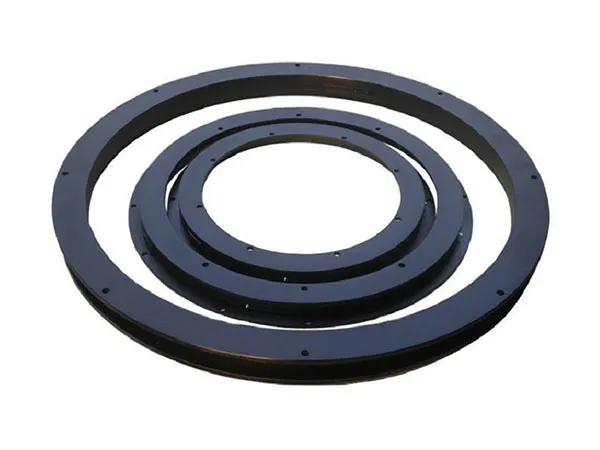
The optimal grade depends on the dominant failure mode expected in service.
Through-hardened steels suffice because impact is minimal, and surface fatigue from rolling elements is not severe. LYMC often supplies 100Cr6-based bearings for these applications with appropriate seal design to mitigate corrosion.
Case-hardened grades are mandatory. The tough core prevents crack propagation from occasional overloads, while the hard raceway resists brinelling. LYMC’s heavy-duty series utilize 20MnCr5 carburized to 1.5 mm case depth for optimal performance.
Stainless steels or through-hardened bearings with specialized coatings (e.g., zinc-nickel plating) are evaluated. For extreme corrosion combined with moderate shock, 17-4PH stainless offers the best compromise. LYMC can provide hybrid solutions where the raceways are stainless and rolling elements are ceramic.
With over a decade of customized bearing production, LYMC does not rely on a one-size-fits-all material specification. Our engineers assess the loading profile, rotational speed, environmental exposure, and expected service life before recommending a grade. We also offer finite element analysis (FEA) to validate that the selected material’s hardness-depth profile matches the contact stress distribution. For clients who need both wear resistance and corrosion protection without the cost of full stainless, LYMC recommends a through-hardened grade with a high-performance duplex coating. This approach has been successfully deployed in harbor cranes and tunnel boring machines.
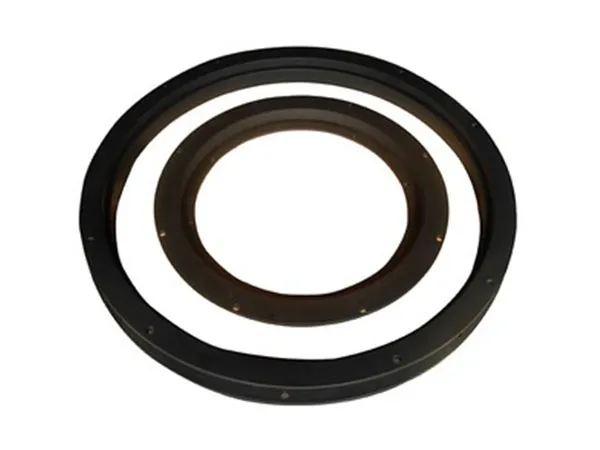
Selecting the right material grade for a slewing bearing is a balancing act between hardness, toughness, corrosion resistance, and cost. Through-hardened steels provide economical wear resistance for stable loads; case-hardened alloys excel where impact and fatigue dominate; stainless grades address aggressive environments at a premium. By understanding your application’s primary failure mode, you can make an informed decision. LYMC stands ready to support that decision with engineering expertise, material traceability, and rigorous quality control—ensuring your slewing bearing delivers the durability your operation demands.