- +86 13837949030 +86 15890619536
- info@lymcbearings.com
- Bearing Zone,Luoxin Industrial Cluster, Luoyang City,Henan Province,China

Time:2026-10-19 03:01:13 Source:LYMC Slewing Bearing
Crossed roller bearings are specified when a machine needs high rigidity, accurate rotation, and a compact envelope — robot joints, machine tool tables, indexing heads, and medical scanners all rely on them. Selecting the wrong configuration, precision grade, or mounting method can degrade positioning accuracy, shorten service life, and inflate cost. This guide explains the structure, the selection parameters that matter, the main design variants, and a step-by-step process engineers can follow to reach a defensible choice.
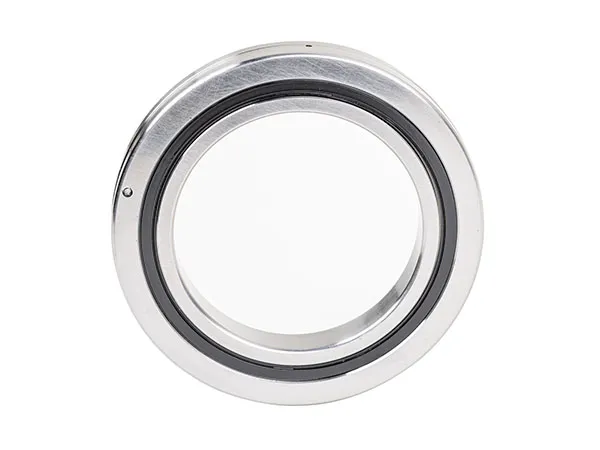
A crossed roller bearing has cylindrical rollers arranged at 90° to one another in a single raceway, alternating in sequence along the circumference. Because the rollers cross, one bearing set carries radial, axial, and moment loads simultaneously. That is the core reason designers choose it over a pair of angular contact ball bearings or a conventional thrust-plus-radial combination.
The trade-off is sensitivity to mounting accuracy and contamination. Crossed roller bearings reward careful design and punish shortcuts in housing preparation.
Selection is not a single calculation. It is a sequence of constraints that narrow the field from hundreds of catalog numbers to one or two viable options.
Every crossed roller bearing carries three load ratings: dynamic radial, dynamic axial, and moment. A robot arm joint may see a small axial force but a large tilting moment. A rotary table may see heavy axial load with modest moment. The selection process starts by resolving the actual load case — including shock factors and duty cycle — into these three components.
Never size a crossed roller bearing on radial load alone. Moment capacity frequently governs the final choice, especially in cantilevered or offset-load arrangements.
Precision grades for crossed roller bearings are typically defined by running accuracy, axial runout, and radial runout. Common tiers map to:
Higher grades cost more and demand tighter mounting surfaces. Specifying ultra-precision on a frame that cannot hold flatness tolerance wastes money.
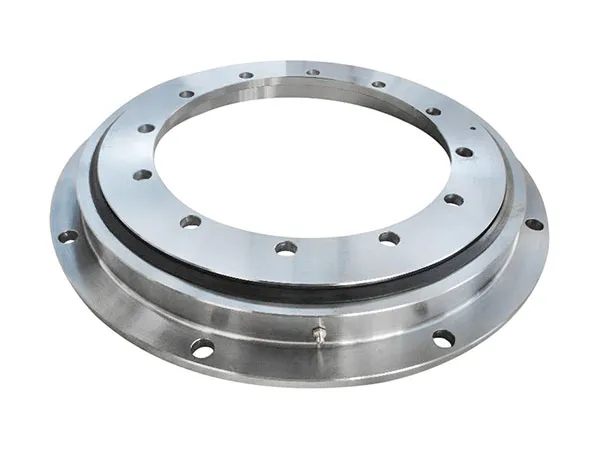
Crossed roller bearings are available with or without inner and outer mounting holes, in open or sealed configurations, and with different preload classes. A bearing with integral mounting holes simplifies housing design and reduces assembly error. Sealed units retain grease and exclude debris but add drag torque — a factor in high-speed or low-torque applications.
Temperature range, vacuum exposure, washdown chemicals, and vibration all influence material, lubrication, and sealing choices. Bearings destined for cleanroom use may require vacuum-compatible grease or dry-film lubrication. LYMC supplies crossed roller bearings in configurations matched to these environments, with documentation that supports the selection record.
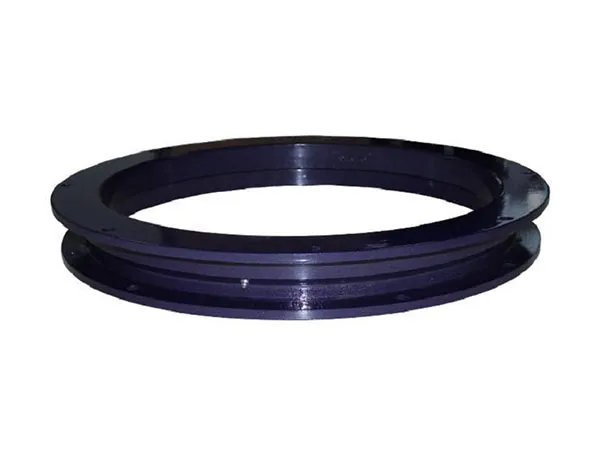
The three common families differ in how the rollers are retained and how the bearing integrates into the machine.
Material and coating choices — standard bearing steel, stainless steel, or surface-treated rings — follow from the environment and required corrosion resistance rather than from load capacity alone.
Working through these steps in order prevents the common failure mode of choosing a bearing that fits the space but cannot carry the moment load.
Two errors appear repeatedly in design reviews. The first is ignoring moment load until late in the project, which forces a larger bearing and a reworked housing. The second is over-specifying precision. A high-grade bearing installed on a machined surface with inadequate flatness will not deliver its rated accuracy, and the extra cost buys nothing.
A third, quieter mistake is mismatching preload to the application. Too little preload allows deflection under reversing loads; too much raises friction and heat. Preload should be specified with the same care as the load rating.
In many rotary axis designs, yes. One crossed roller bearing handles radial, axial, and moment loads, simplifying the assembly. Verify stiffness and life against the combined load case before committing.
Choose full complement for maximum stiffness and load capacity at low speed. Choose caged when speed, friction, or heat generation matters more than peak load.
Housing and shaft flatness, perpendicularity, and roundness tolerances depend on the precision grade. Higher grades require tighter tolerances, often in the range of a few micrometers.
Yes. Grease selection affects torque, temperature limits, and service interval. Vacuum, cleanroom, and high-temperature applications may require alternative lubrication strategies.
Crossed roller bearing selection rewards a disciplined sequence: define the load case, size for moment as well as radial and axial forces, match precision to the real accuracy requirement, and confirm the mounting environment can support the chosen grade. Engineers who treat these steps as a checklist rather than a formality end up with rotary axes that hold position, last their intended life, and avoid the cost of a redesign.