- +86 13837949030 +86 15890619536
- info@lymcbearings.com
- Bearing Zone,Luoxin Industrial Cluster, Luoyang City,Henan Province,China

Time:2026-09-07 03:01:34 Source:LYMC Slewing Bearing
The clearance of a slewing bearing directly determines the operational stability, load distribution, and service life of an excavator. An improper clearance can lead to excessive vibration, accelerated wear, or even catastrophic failure of the superstructure. For maintenance teams, equipment dealers, and fleet managers, understanding what constitutes the ideal clearance is not merely technical—it is a financial decision affecting downtime and repair costs. This article explores the definition, influencing factors, industry-recommended values, and how to verify the correct clearance for your excavator. We also highlight how LYMC applies precision engineering to deliver bearings that meet or exceed OEM specifications.
Slewing bearing clearance, often referred to as axial or radial play, is the measured gap between the rolling elements and the raceways under a defined load condition. For excavators, the clearance is critical because the bearing must handle combined axial, radial, and tilting moment loads during digging, swinging, and lifting operations.
For excavator slewing bearings, the most commonly referenced parameter is the axial internal clearance measured under a standard preload (typically 500–1000 N). The ideal value is a balance: enough clearance to prevent jamming from thermal expansion, but not so much that it causes slop and uneven load distribution.
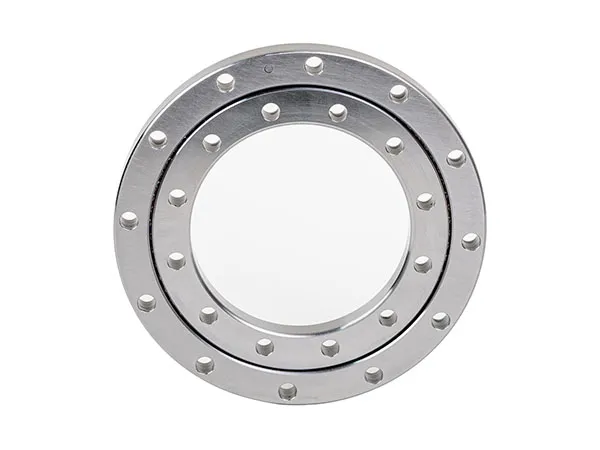
Selecting the correct clearance requires evaluating several operating conditions. No single value fits all excavators.
Excavators experience high tilting moments during digging. A bearing that is too loose will allow excessive tilting, accelerating raceway and ball wear. Conversely, a bearing that is too tight may induce high internal stress, reducing fatigue life. For standard excavators (20–50 ton class), axial clearance typically falls between 0.04 mm and 0.12 mm (40–120 microns) for single-row ball slewing rings, and 0.08–0.20 mm for cross-roller types.
Excavator slewing speeds are low (usually 1–5 rpm), so heat generation is modest. However, in hot climates or continuous heavy digging, the bearing temperature can rise 15–30°C above ambient. Thermal expansion of the raceways reduces clearance. Engineers often specify an initial clearance at the upper end of the tolerance band when the excavator will work in high-temperature environments.
The clearance must also account for the flexibility of the mounting bolts and the housing. A flexible connection can amplify clearance effects. LYMC recommends evaluating the actual bolt torque and housing flatness before final clearance selection.
There is no universal standard across all excavator brands, but several recognized norms exist. The following values are derived from ISO 281 and common OEM practices:
| Excavator Weight Class | Slewing Bearing Type | Axial Clearance Range (mm) |
|---|---|---|
| 10–20 ton | Single-row ball | 0.03 – 0.08 |
| 20–40 ton | Single-row ball / Crossed roller | 0.05 – 0.12 |
| 40–70 ton | Crossed roller / Three-row roller | 0.08 – 0.20 |
| 70+ ton | Three-row roller | 0.12 – 0.25 |
These ranges serve as starting points. The final specification should be verified through load simulation or field testing. LYMC offers customized clearance adjustments according to customer application data.
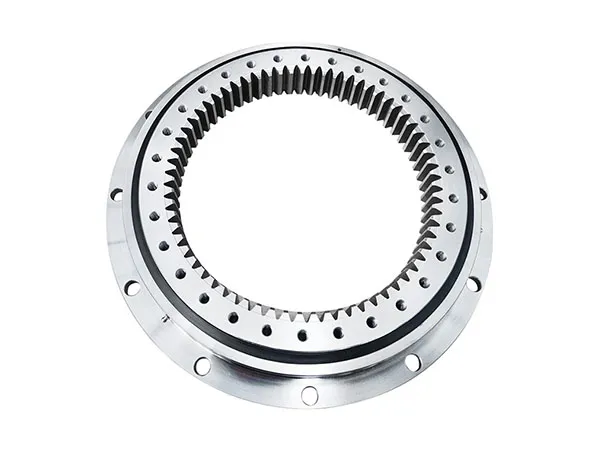
Clearance measurement should follow the manufacturer's procedure. For most excavator slewing bearings, a dial indicator is used to measure axial displacement under a known force or dead weight.
The reading is the axial internal clearance. If the value lies outside the tolerance band, the bearing may need to be replaced or shimmed. In practice, many excavator failures attributed to “bearing slop” are actually due to bolt loosening or raceway spalling—misdiagnosis is common.
LYMC specializes in producing slewing bearings for heavy construction equipment with a focus on precision clearance control. We achieve this through:
Our long-term customers report a 25–30% reduction in unscheduled slewing ring replacements compared to generic aftermarket bearings.
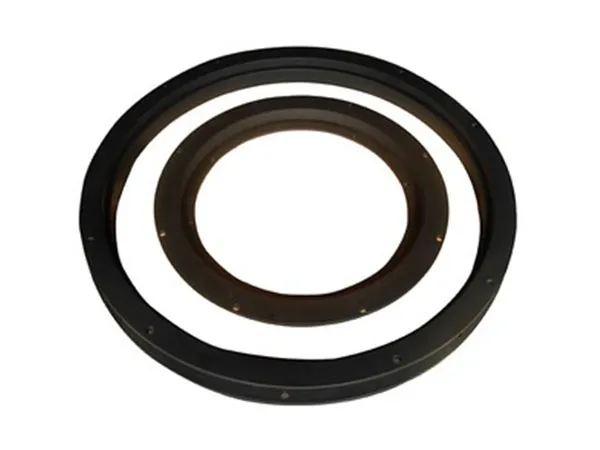
Yes, axial shims can be used to compensate for excessive clearance, but only if the bearing is otherwise in good condition. LYMC recommends consulting an engineer before shimming, as improper shim placement can create uneven load paths.
Excessive clearance causes hammering between rolling elements and raceways, leading to rapid wear, noisy operation, and reduced swing accuracy. Over time, it can crack the raceway or break gear teeth.
For excavators in heavy service, check clearance every 2000 operating hours or when you notice increased backlash while swinging. LYMC provides a free clearance checking guide with every bearing order.
The ideal slewing bearing clearance for an excavator is not a single number—it is a carefully selected value that aligns the bearing's internal geometry with the actual loads, speeds, and environment of the machine. By understanding the types of clearance, the factors that influence it, and the standard ranges for your excavator class, you can make an informed decision that maximizes equipment uptime and reduces total cost of ownership. For applications where precision and durability are non-negotiable, LYMC offers engineering support and custom clearance solutions backed by years of industry experience.