- +86 13837949030 +86 15890619536
- info@lymcbearings.com
- Bearing Zone,Luoxin Industrial Cluster, Luoyang City,Henan Province,China

Time:2026-07-20 03:01:07 Source:LYMC Slewing Bearing
Choosing between a single-row and a double-row slewing bearing is a critical decision that directly impacts the performance, durability, and cost-efficiency of your rotating equipment. Whether you are designing a new crane, excavator, wind turbine, or robotic arm, the wrong selection can lead to premature failure or unnecessary expense. This article provides a professional, side-by-side comparison of single-row and double-row slewing bearings, covering structural differences, load capabilities, stiffness, maintenance, and typical applications. With insights from LYMC, a leading manufacturer of precision slewing bearings, you will gain the clarity needed to make an informed choice.
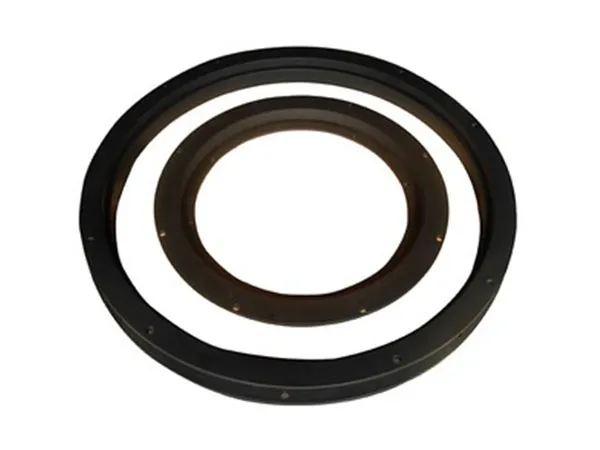
A single-row slewing bearing consists of one row of rolling elements (balls or rollers) arranged in a single raceway. This design is compact, lightweight, and cost-effective. It can handle moderate axial loads, radial loads, and tilting moments simultaneously, making it suitable for many light-to-medium duty applications. Common uses include small cranes, aerial work platforms, solar trackers, and medical equipment.
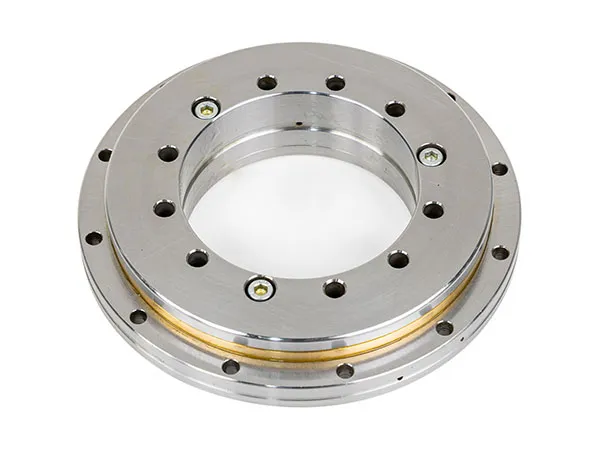
A double-row slewing bearing features two rows of rolling elements, usually with a larger cross-section and more robust raceways. The dual-row configuration significantly increases load capacity and stiffness, especially for tilting moments. These bearings are engineered for heavy-duty equipment such as large excavators, offshore cranes, wind turbine yaw systems, and military vehicles. They offer higher rigidity but come with increased weight, size, and cost.
Understanding the fundamental contrasts helps narrow down your options. The table below summarizes the main differences, but we will explore each aspect in detail.
When evaluating load capacity, consider axial load, radial load, and tilting moment simultaneously. Single-row slewing bearings typically handle up to moderate moment loads (e.g., 50 kN·m range), while double-row variants can exceed 500 kN·m in the same outer diameter class. For example, a standard single-row bearing with a 1000 mm outer diameter can support roughly 200 kN axial load, whereas a double-row bearing of similar size supports more than 400 kN axial load and triples the moment capacity.
Stiffness is crucial for precision applications like robotics or machine tools. Double-row bearings have a larger effective load center and more rolling contacts, resulting in higher stiffness—often two to three times that of a single-row equivalent. This reduces deflection and maintains accurate rotation under varying loads.
Double-row bearings distribute stress over more contacts, lowering contact pressure and extending fatigue life under heavy loads. However, single-row bearings can achieve excellent service life if operated within their rated capacity. Proper lubrication and sealing are equally important for both types. LYMC recommends consulting the classic L10 life calculation method, factoring in dynamic load ratings and operating conditions.
The selection ultimately depends on your equipment’s load profile, speed, precision requirements, and budget. Below are typical scenarios:
If your equipment operates in harsh environments (e.g., dust, saltwater), double-row bearings often allow better sealing integration. Conversely, if weight reduction is a primary concern (e.g., aerospace or mobile equipment), a single-row design may be preferable even at lower load margins.
LYMC has been manufacturing high-precision slewing bearings for over a decade, serving industries such as construction, renewable energy, mining, and defense. Our single-row and double-row slewing bearings are made from premium alloy steel (typically 42CrMo or 50Mn), heat-treated for optimal hardness and wear resistance. Every bearing undergoes CNC machining, magnetic particle inspection, and assembly tolerance verification per ISO 9001 standards. LYMC also offers customized designs—different raceway profiles, gear teeth (internal/external), mounting hole patterns, and sealing options—to match your exact requirements. Our engineering team assists with load calculations and finite element analysis to ensure you select the right bearing type from the start.
In summary, the decision between single-row and double-row slewing bearings hinges on load conditions, stiffness needs, and budget constraints. For moderate loads and cost-sensitive projects, a single-row bearing provides an excellent balance of performance and economy. For heavy-duty, high-precision, or long-life applications, a double-row bearing is the superior investment. Whichever path you choose, partnering with a reliable manufacturer like LYMC guarantees technical support, quality control, and after-sales service. Contact LYMC’s slewing bearing specialists to discuss your specific application and receive a tailored recommendation.